

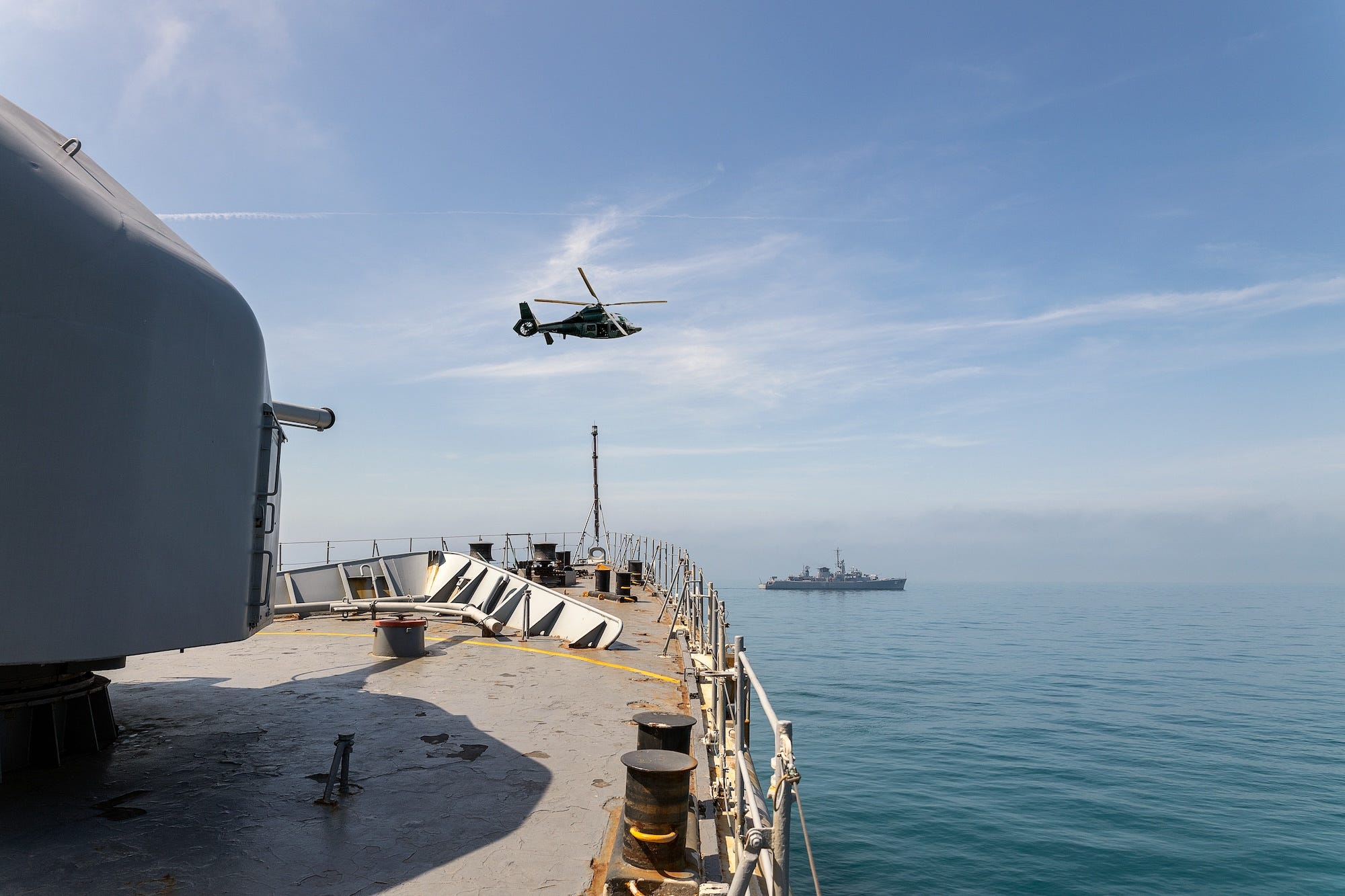
In October 1962, President John F. Kennedy ordered a naval quarantine of Cuba to pressure the Soviet Union into withdrawing ballistic missiles it had secretly placed there. The term quarantine was chosen very deliberately to avoid using the much thornier word blockade, which would have been an act of war. It was a carefully crafted combination of substance and semantics designed to avoid conflict while preserving deterrence. It worked.
The Cuban Missile Crisis is now remembered as an exemplar of confident, calculated American statecraft, despite the risks involved. To that common reading, I would make one change: because of the risks, not despite them. It’s a distinction Britain, and much of Europe, could learn from today.
The Kennedy administration understood two things which we have forgotten in our current strategic contest with Russia: how to effectively navigate the space between war and peace, and that deterrence requires demonstrating the capacity to accept risk, not just maintain capability. Today, Britain is one miscalculation away from war with Russia because we have failed on both counts.
There is a step Britain can take that will rectify both failures. It requires exercising strategic imagination the British state has largely forgotten it possesses, but upon which peace and security in Europe may now depend.
That step is to recognise a new category of interstate relations. Not peace, not war, but a third category that acknowledges Russian hostility towards the UK and its allies, and enables us to develop a framework for responding through coercive action that is impermissible in peacetime but stops short of armed conflict.
A state of hostility.
Russia’s hybrid campaign and the collapse of British deterrence
When Alexander Litvinenko was assassinated by Russian agents on British soil in 2006, the government’s primary response was to expel four Russian intelligence officers and suspend official contacts with the FSB. A coercive, hostile act was met with a scrupulously diplomatic, peacetime response. This pattern has repeated continuously since. The Salisbury poisonings: diplomatic expulsions. Cyberattacks: formal condemnation and defensive hardening. Spying on undersea cables: tracking and monitoring. Arson attacks: domestic prosecution. Every escalation is met with predictable caution and restraint. Every response teaches Russia the same lesson: push further. And that’s exactly what they’ve done.
During the Cuban Missile Crisis, Kennedy’s quarantine gambit involved significant immediate risk. The administration was particularly concerned that the Soviets would respond by attempting to blockade Berlin. But that risk was traded against a much greater strategic risk: that failure to meet a hostile action with clear resolve would reward the initial provocation and invite further escalation. To protect Berlin in the long term, Kennedy understood he needed to show he could tolerate risk when American credibility was on the line.
In dealing with Russia today, Britain has made the mistake Kennedy avoided. In prioritising restraint and de-escalation in the short term, we have in the long term invited the very thing we sought to prevent. We have shown Russia that we are not willing to accept risk. We can spend as much on defence as we like – and you could argue we’re not spending nearly enough – but capability is only one half of deterrence; the other is a willingness to use it if necessary. Russia has become so convinced that Britain, and Europe, will not respond forcefully to aggression that intelligence suggests they are now planning a limited attack on NATO territory to test the alliance. This would be a fateful miscalculation – but it’s also the logical culmination of an escalatory chain we have failed to break.
When looking at an individual incident, the arguments for restraint are not unreasonable. Do we want to risk confronting a nuclear power over an arson incident? Do we want to risk our broader reputation by responding coercively to an incident even if that comes into tension with international law? Is it not sufficient to counter a threat by making ourselves more resilient against it? These arguments can all be dispelled individually, but they also fail collectively when we zoom out and observe the pattern: these are not isolated incidents but a pattern of continuous, escalating attacks that are designed to degrade and undermine the British state. We must respond to the pattern, not the incidents, and that warrants a much stronger and more comprehensive response.
A state of hostility
Responding to the pattern requires a new strategic and legal vocabulary. Our current approach is stuck in an obsolete peace/war binary: we’re not at peace because we’re being attacked, but those attacks do not clearly cross the threshold of war, so we default to a mismatched peacetime response that erodes and eventually collapses deterrence.
The solution is for Britain to assert a new doctrine: when we come under sustained attack below the traditional threshold of war, we will consider ourselves in a state of hostility with the opposing power. This will enable us to take a range of coercive measures that go beyond what’s normally permissible in peacetime, but stop short of armed conflict. This is Kennedy’s quarantine gambit – calibrated to sit between peace and war – turned into a framework that can be utilised across multiple domains.
This state of hostility is not an attempt to disavow international law, but to challenge its inadequacy and seek to change it. Too often, the British state treats international law as a fixed body of rules that defines the limits of permissible statecraft. But international law has never been static. States themselves have shaped it through practice, precedent and the articulation of new legal principles. Britain should recover a much older, more confident and imaginative tradition of statecraft: one in which we do not merely follow the rules, but create them.
By the early 1800s, Britain was a major beneficiary of a principle that had become firmly entrenched in customary international law: freedom of the seas. As a state building a global empire on the foundation of maritime commerce, this suited us. But in 1807 Britain had a problem. That year, it abolished the slave trade, making it impossible for British ships to transport slaves. But the trade continued under foreign flags – something that Britain became increasingly determined to end. Interfering with ships under a foreign flag was incompatible with freedom of the seas, so we faced a strategic dilemma: undermine the rules on which our maritime power was based, or accept the continuation of a trade we had come to regard as intolerable.
The British statecraft of the early 1800s was imaginative enough to escape this false binary. The answer wasn’t to follow the rules, and it wasn’t to disregard them. It was to make new ones. Over the next two decades, Britain energetically pursued international treaties establishing reciprocal search rights with other flag states. Under these treaties, the right of inspection for anti-slavery purposes increasingly became the norm rather than the exception, and around it an increasingly sophisticated legal architecture emerged, including international tribunals established to adjudicate on captured slave ships. Today it has become an established exception to freedom of the seas, enshrined in the United Nations Convention on the Law of the Sea.
Britain is not the only state to have done this. The concept of freedom of the seas itself first arose as a reaction against imperial powers attempting to establish sovereignty over the oceans. What started as a niche idea articulated by the Dutch jurist Hugo Grotius in the early 1600s eventually became dominant because it won the argument and suited the interests of maritime powers. In 1945, President Truman unilaterally updated the rules with the Truman Proclamation on the Continental Shelf, asserting US jurisdiction and control over the natural resources of the continental shelf contiguous to its coast. Other states followed suit, and the principle is now codified in the law of the sea alongside the anti-slavery exemption.
Like Grotius and Truman, the Britain of 1807 understood that international law is an arena for the conduct of statecraft. Today, so focused on following the rules, we have forgotten how to change them. It is time to remember. Russia exploits the gap between peace and war. Britain can create the legal and strategic architecture to fill it, and fight back. And the first step follows on almost directly from Britain’s anti-slavery statecraft: creating a new exception to freedom of the seas in order to dismantle Russia’s shadow fleet.
Dismantling the shadow fleet
In the early hours of 14 June, Royal Marines from 42 Commando fast-roped onto the sanctioned oil tanker Smyrtos and detained it while it was transiting the English Channel. This was notable in being the first – and so far only – time Britain has interdicted a sanctioned vessel, but it was not game-changing. In the absence of further interdictions, it remains an isolated action rather than a systematically enforced policy. The main effect has been displacement, pushing some shadow tankers on to longer routes around Scotland and Ireland, while others continue to transit the Channel.
A big part of what stops Britain and other European countries from conducting interdictions more systematically is the limited grounds on which they can legally do so. The law of the sea guarantees freedom of navigation in international waters except under limited circumstances, such as a ship being stateless or, of course, being involved in the transportation of slaves. In the case of the Smyrtos, statelessness was the legal basis used, after its flag state, Cameroon, expelled it from the register under European diplomatic pressure.
The shadow fleet is adept at manipulating registries, with ships frequently swapping flag states and, in the last resort, reflagging to the Russian registry – a shift that is increasing as other flag states crack down. Relying on statelessness and other existing exceptions to freedom of navigation will only ever allow Britain and our European allies to play whack-a-mole.
If Britain were at war with Russia, none of the ordinary restrictions on interdiction would apply. But in peacetime, they do. The law of the sea recognises nothing in between, and that’s where the state of hostility comes in. Upon declaring a state of hostility with Russia, Britain should argue a new exception to the law of the sea arises from this intermediate state of relations, allowing for systematic shadow fleet interdiction where certain conditions are met: either a vessel is creating a security threat by loitering around critical infrastructure, or it is suspected to be engaged in hybrid warfare activities, or it is involved in the financing or provision of Russian hostile actions against Britain and its allies, including Ukraine.
This would not be a sweeping blockade of all Russian exports and imports, but rather a targeted right to board and seize ships that are involved in the commission or financing of hostile acts. It would apply anywhere in international waters, ensuring the shadow fleet can be systematically dismantled in the Channel, the North Sea, the Baltic Sea, or much further afield.
This new right of interdiction exists nowhere in current international law, but there is a body of law from which it can borrow, and from which it could naturally extend: the customary international law of state responsibility, codified in large part by the UN in the Articles on Responsibility of States for Internationally Wrongful Acts. The articles allow a state to withhold performance of its ordinary international obligations towards another state, in this case our obligations under the law of the sea, as a countermeasure against an internationally wrongful act: Russia’s ongoing hostile acts against the UK and its allies.
While the law of state responsibility does not provide complete legal cover for rewriting, or suspending, the law of the sea, and does not refer to hybrid warfare or a state of hostility, it does provide enough substance to construct a credible initial defence against any legal challenge Russia might attempt to lodge. Since such a challenge may take years to reach a conclusion, this gives Britain time to establish its new doctrine through practice and coalition-building.
That last part is particularly important. Britain cannot and should not do this alone. To make the state of hostility doctrine durable, a small coalition of likeminded states with the will and capacity to enforce it should be assembled. The Joint Expeditionary Force (JEF) is one possible option: its members share similar threat perceptions regarding Russia, it’s small and nimble enough to avoid political obstruction, and it has naval capabilities that are already used to monitor the shadow fleet. A joint declaration on a state of hostility with Russia by the JEF states, together with a common policy on interdiction, would give the doctrine teeth.
Britain should expect Russia to challenge such interdictions in international courts and tribunals. That would not represent a failure of the strategy, but part of it. Britain would defend its actions by drawing on the existing law of countermeasures while arguing for the recognition of a new rule adapted to sustained hostility below the threshold of armed conflict, making the courts part of the process. Whether that argument ultimately succeeds would depend not simply on what Britain says, but on whether other states adopt the doctrine, apply it consistently, and defend its legality.
International law as an instrument of statecraft and deterrence
The concept of advancing an incomplete legal argument to defend Britain in the courts while reshaping international law through practice is inherently alien to our present-day strategic culture. As the Council on Geostrategy commented in its recent report on asymmetric statecraft, we are too often ‘mired in post-Cold War habits of legalism, risk aversion, and process compliance’. When Britain committed to ending the slave trade, it did not merely ask whether existing international law allowed it. It asked how existing rules could be reshaped to serve Britain’s goals. That spirit must be rediscovered.
We do not face a binary choice between legal compliance and legal innovation. As the old order fractures, Britain can choose which of its rules it thinks are worth defending, which need to be reshaped, and which should be discarded, rather than following all of them without question to the graveyard of the rules-based international order. In doing so, we become an active state shaping what comes next, not a passive witness bounced around by changes taking place beyond our reach.
In taking this approach, Britain could turn international law from a hindrance in the contest against Russia into an asset. A state of hostility could reshape that contest, not just in the maritime domain but wherever else it unfolds. Russian assets could be seized and used to fund Ukraine’s defence, not just frozen. Cyber-attacks could be met with proportionate retaliation, not just further hardening. Russian-directed drones could be shot down not just when they reach European territory, but when they get too close to it. A state of hostility becomes the legal and strategic framework for a more assertive, and much more effective, approach to defending against and deterring Russia.
When President Kennedy was confronted with the Soviet Union’s missiles in Cuba, there were some who argued for an exclusively diplomatic solution, and more still who argued for direct military action. These opposite responses would have ended in the same place, just at different speeds. Diplomacy by itself would have confirmed to the Soviet Union that provocation would be met with de-escalation, paving the way for further provocation and ever greater risks of miscalculation and war. Military action threatened a more immediate route to the same destination by humiliating Moscow and compelling an equally destructive response. The naval quarantine, however, was a third way that involved risk but avoided disaster, combining legal innovation with carefully calibrated deterrence. Today Britain and Europe must accept risk to avoid disaster, and remember that ‘the greatest danger of all would be to do nothing’.