

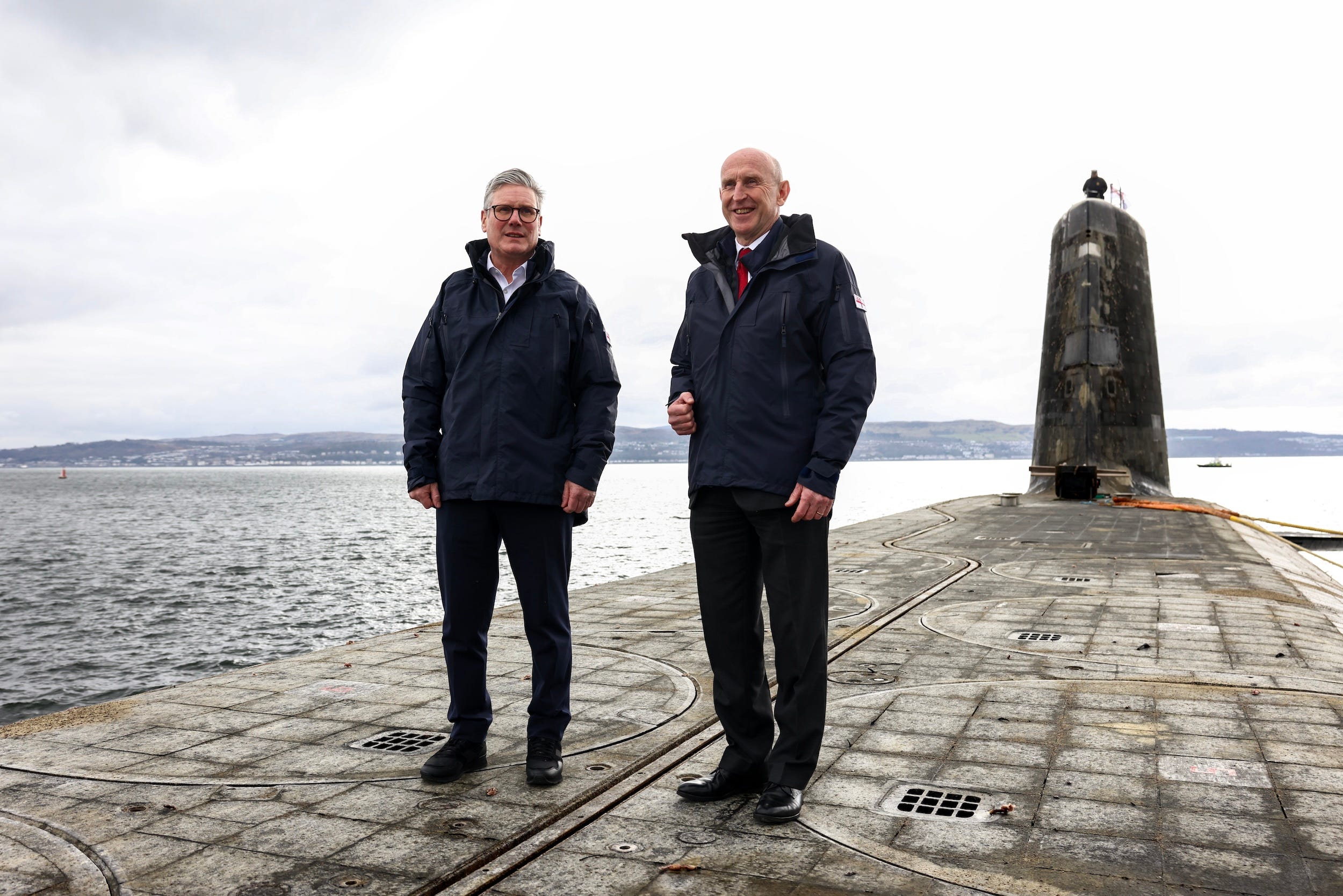
The long-delayed Defence Investment Plan is finally (almost, maybe) here, though not before claiming the resignation of Defence Secretary John Healey over its funding settlement.
If reporting is to be believed, it has been funded by raiding capital budgets across Whitehall. This, unfortunately, is one of the worst ways to fill the gap. It pays for our defence today by endangering our security tomorrow.
Defence is not just the technology and weaponry needed to go into combat, but the broader resilience of our economy and society. Decades of underinvestment in energy, infrastructure, and public services have left our country vulnerable to external pressures and shocks, and our people disenchanted and divided. By raiding the budgets intended for projects that would reverse the damage, we only increase our insecurity.
Over the last few weeks, two debates have emerged: one about how we fund our defence in a new era of geopolitical challenge, and the other about how we revive our dysfunctional economy. These two debates are happening independently of each other, but they shouldn’t be: in fact, they are indivisible.
In this edition of Signals, Future Statecraft’s regular roundup briefing on foreign policy, defence, and international power, we’ll explore how that connection plays out and why it matters.
Andrew Noakes, Future Statecraft
One of the ultimate goals of defence is to protect British sovereignty, but in this era of weaponised interdependence, our sovereignty is as much endangered by energy insecurity, technological dependency, and the outsized role of foreign capital in our economy as it is by Russian aggression. Writing in the New Statesman, Mathew Lawrence argues that the vision of a Productive State combines economic transformation with geopolitical advantage:
The Productive State delivers sovereignty advantages that markets systematically underweight and that the current geopolitical moment makes newly urgent. Price sovereignty: the ability to insulate domestic households and firms from the transmission of global market shocks into bills and input costs. Supply chain sovereignty: maintaining domestic productive capacity for the equipment, components, and materials on which the energy transition depends, rather than trading one geopolitical dependency (imported fossil fuels) for another in the form of imported clean tech goods and capital. And ownership sovereignty: ensuring that essential infrastructure is not progressively acquired by owners whose interests lie elsewhere.
While some argue that new institutional models can unlock greater investment within existing fiscal constraints, others believe the constraints themselves need reform. Writing in Renewal, Louise Haigh MP argues for fiscal reform that would underpin long term public investment in the British economy, putting an end to the short termism that has held back growth:
The current fiscal framework is unfit for purpose and unable to deliver the economic renewal we in the Labour Party believe our country needs. The status quo is not a neutral baseline – it is a path to continued stagnation. Longer time horizons, new and better empowered institutions, and a greater investment capacity for those parts of the state that already exist should be the building blocks of a credible growth plan that would in turn buy us trust from the markets.
Funding public investment without spooking the bond markets will be a delicate balancing act. In Arguably, George Eaton reminds us that market scepticism about Britain is itself a drain on our resources and a source of insecurity. Restoring confidence, he argues, means getting serious about spending reform, starting with the triple lock:
The persistence of the “triple lock” on the state pension, as the IMF notes in its latest verdict on the UK, is perhaps the best example. In a country in which three million people aged over 65 now live in millionaire households, we have persisted with an extravagantly untargeted policy. Moving to a measure based on the average of inflation and wage growth, the Intergenerational Foundation estimates, would save £19bn a year by 2035, £28.5bn a year by 2040 and £38bn a year by 2045.
Addressing the dysfunction in our political economy, particularly with respect to the triple lock, is part of this puzzle. But changes must be targeted to avoid a broad return to austerity, otherwise we risk undermining the economic security we’re trying to create, which in turn undermines our defence. As Clive Lewis MP warns in Byline Times, people will not defend a country they have no stake in:
The familiar framing, that social spending is what must be sacrificed to meet the NATO target, is not merely politically toxic. It is strategically illiterate. Cutting the foundations of social cohesion to fund the hardware of national defence is self-defeating. You end up with planes and no pilots, submarines and no crew, an army that cannot recruit because the society it is meant to protect has stopped believing in itself.
This runs to the heart of the connection between economic transformation and defence. Public investment is not just a national or abstract need, but a human one. As Al Carns, (now former) Minister for the Armed Forces, argues in the New Statesman, a strong defence requires a strong country, which requires resilience all the way down to the individual:
We often talk about defence, the economy, the NHS, education and energy as if they are separate conversations. They aren’t. You can spend billions on defence, but if families are struggling and the economy is under strain, you are kidding yourself about how strong this country really is. If families are one bill away from trouble, the country is not stable.
The other side of this coin is that increased defence spending must have public support, which is where political difficulties arise. As Evie Aspinall writes, the public are reluctant to accept trade-offs:
So while Britons broadly support increasing defence spending, our research consistently shows that they are unwilling to make the necessary trade offs, either in the form of cuts to welfare, health or education, or through increases to their taxes to fund it. That puts our democratically accountable leaders in a tough position. They have very little fiscal or political headroom. Certainly not enough to fund the vast and rapid increases in defence spending that military leaders would like to see.
This conversation has an international dimension too. Strengthening British security, sovereignty, and economic power means developing partnerships with likeminded countries on defence, energy, and technology in a way that multiplies power without locking in dependence. IPPR’s recent report on diversifying diplomacy suggests a way forward:
Weaponised interdependence has become the hallmark of 21st century statecraft, posing as yet unanswered questions for the state’s approach to delivering prosperity and security.
Britain should respond decisively. First, it should identify chokepoints in a small number of ‘core’ domains that underpin long-term security and productive capacity – we suggest defence, energy and AI. Second, it should identify and build new partnerships that mitigate these vulnerabilities and deepen areas of UK comparative advantage.
As the transatlantic alliance falters and Britain’s future in Europe remains an open question, Britain could look to fellow middle powers for such partnerships. The New Diplomacy Project proposes a new ‘trusted six’ format:
The T6 is a proposed grouping of established middle powers – the UK, Japan, South Korea, Canada, Australia, and New Zealand. These states share many features including democratic governance systems, advanced economies, and a track record of engaging with the EU across many fronts… In the T6 model, this grouping could negotiate on a collective basis with the EU to co-create partnerships that bolster the economic security and resilience of all.
These proposals suggest a third interrelated debate is needed: on Britain’s place in the world. As Ben Judah writes, the current Labour leadership shadow contest has ignited a welcome debate on the economy, but it’s quiet about geopolitics. Yet the latter is just as important to Britain’s future:
Anyone currently inside the system, or frankly outside it, knows the world is changing fast and we have very real choices to make. That’s why Labour also needs a proper debate on foreign policy. So what are the choices Labour’s leaders need to address? Anyone seeking to be Prime Minister needs a clear answer to these four sets of questions on China, the United States, Europe and the Middle Powers, and to be able to explain how these all add up into a strategy.
Whatever path we choose, Britain won’t have credibility with allies in the future if it can’t follow through on the commitments we’ve already made. Matthew Palmer writes that the failure to produce a properly funded Defence Investment Plan leaves Britain’s defence in disarray, and our credibility with partners undermined:
The Prime Minister of Japan is visiting this week, and GCAP is likely to be high on the agenda. The Japanese have been very patient but increasingly infuriated by the UK’s prevarications and refusal to commit spending to this critical defence project. Furthermore, if Starmer can’t get the Defence Investment Plan over the line by the NATO Summit in Ankara in July, or the investment is unsatisfactory, Britain’s reliability as an ally within Europe is going to be heavily questioned.
Britain’s defence debate traditionally revolves around percentages of GDP and procurement plans, and as the DIP debacle shows, those things matter. Yet the deeper question is whether we can build and sustain the economic foundations – and the international partnerships – that make defence durable. Security, growth, and sovereignty are not competing priorities. In the years ahead, they will succeed or fail together.
P.S. These themes are explored further in my recent essay, Breaking the Rules for Defence, which proposes a British Autonomy Bond – a national investment vehicle designed to fund projects, programmes, and technologies that will contribute to British autonomy. Part financial instrument, part political mobilisation tool, it draws on a framework that sees defence and economic security as indivisible and aims to mobilise public support and capital for both.