

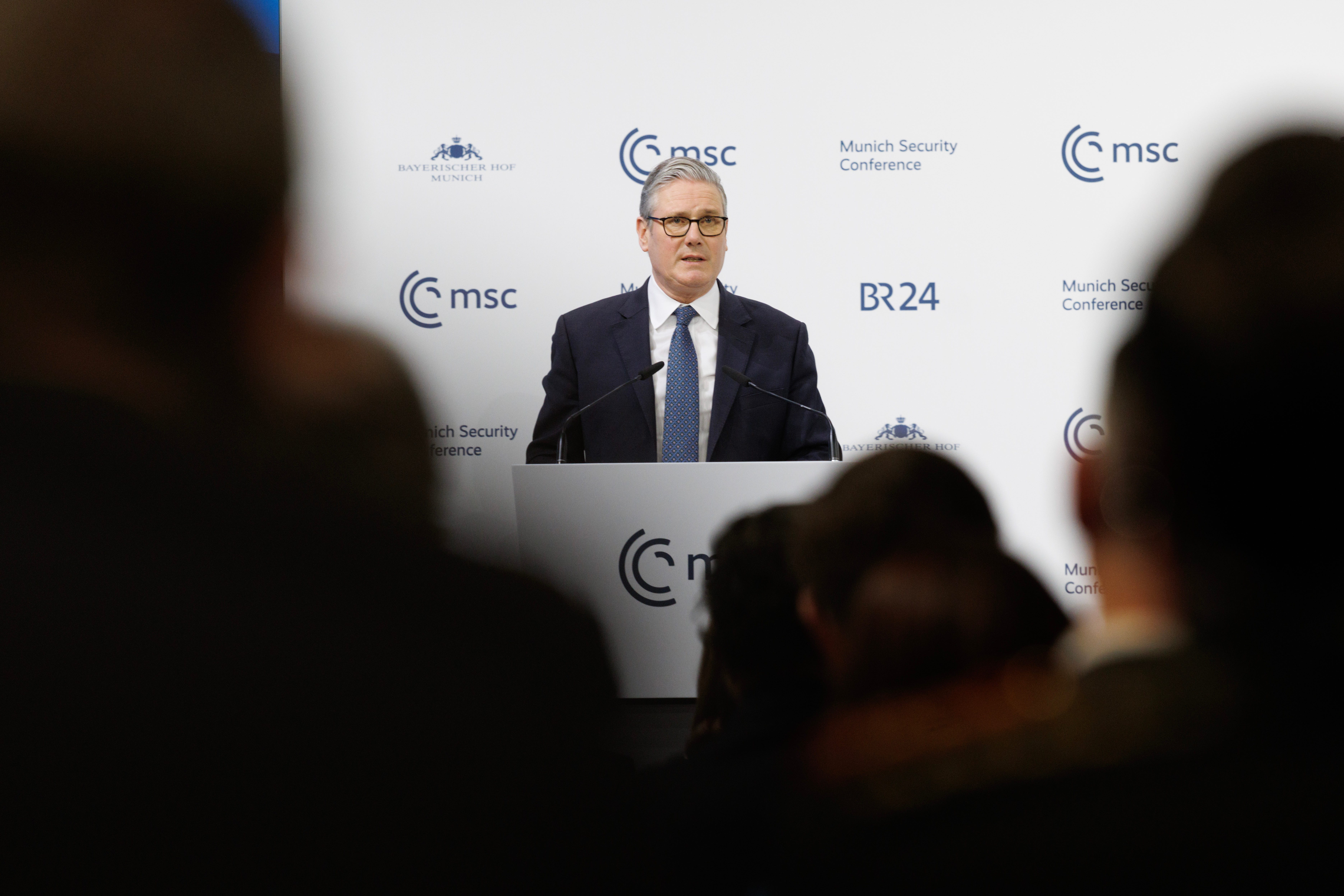
In the weeks since Keir Starmer’s speech to the Munich Security Conference, my mind keeps returning to two ignominious episodes in British history: the Suez Crisis and the Iraq War. Suez taught us the danger of acting – and thinking – independently. Iraq taught us to be sceptical of our capacity and our motivations on the world stage. In their combined shadow, we can trace the outline of Britain’s strategic drift today, so perfectly encapsulated in that Munich speech.
If you expect me to excoriate the prime minister and his team, then you misread me. For his task is not only to grapple with the unravelling of the transatlantic alliance just at the moment it is most needed, but to respond by shaking off the spectres of both Suez and Iraq simultaneously. The constraints are not just born of capability deficits and alliance politics, but embedded deep within the institutional psychology of the British state, and beyond it, the nation as a whole. Breaking free of that requires a deeper reckoning.
The prime minister’s Munich speech was in fact a welcome upgrade to the usual continuity rhetoric. He rightly called for Britain to play a pivotal role in a more European NATO, to end capability duplication through European cooperation, and for faster rearmament. He acknowledged US disengagement, even if the transatlantic alliance was still cast as indispensable, and the real prospect of a wider war in Europe. All of this is important.
But it is one step behind the real conversation Britain needs to be having. And the distance between these two conversations is creating an ever-widening strategic gap in British foreign policy.
That gap is threefold: between rhetoric and action, between the British reading of the transatlantic alliance and the reality, and between the leadership role now demanded of Britain and the more passive role it is stuck playing.
How we arrived here
When Anthony Eden embarked on the ill-fated Suez intervention, and Tony Blair on the Iraq War half a century later, neither would have foreseen the long-term strategic consequences. For Eden, Suez was about Britain protecting its economic interests and exercising its role as a primary global post-war power. For Blair, Iraq was about Britain fulfilling its role as a key US ally and junior guarantor of the liberal world order. Both would have felt the winds of power behind them.
But as Eden helplessly watched the Bank of England’s reserves deplete in response to the crisis, forcing him to succumb to US pressure to withdraw from Suez in humiliation, he must have sensed the sands shifting. So too for Blair as he watched the legal and moral case for the Iraq War unravel and a catalogue of setbacks and maladies emerge.
Suez and Iraq did not alone create our present predicament, but both have had an outsized influence in shaping the confines of our strategic culture and conditioning the response. Suez put a crack in the façade of British power, and from that moment the mirror Britain held to itself became ever more fragile. We came to rely upon the special relationship not just to break the fall of our declining power but to cushion our self-image, too. Iraq, then, was both symptom and accelerant. Separation from the US was by then hard to imagine, but the war smashed what remained of Britain’s strategic confidence – and our moral confidence too. Only the glue of American power and friendship could now keep Britain’s brittle strategic culture intact in the new century – a conclusion solidified by Brexit, which tragically undermined Britain’s primary alternative path.
Now America under Trump has done what Britain was never prepared to do – let the mirror shatter, and the pieces fall. The Greenland Crisis exposed the precariousness of binding British statecraft ever tighter to the fortunes of the special relationship. It is now up to Keir Starmer to do what successive prime ministers before him have refused to countenance – pick up the pieces and put them back together in a new configuration.
But the task is immense. British foreign policy is shackled within interlocking layers of constraint. At the top there is deep psychological dependence on Washington and atrophied strategic imagination, leading to the narrowing of options because the lens itself is narrow, not the options. This is only reinforced by the institutional caution of the British state, naturally inclined to anchor Britain’s response in strategic orthodoxy.
Next comes the danger from Russia – the most urgent security threat Britain faces. If ever the transatlantic alliance were needed, it is now. This makes it much easier to dismiss a policy of autonomy from Washington as reckless, even as Washington itself makes territorial claims on Britain’s European allies and proves indifferent to Russian aggression.
Connected to this is public unease about the cost of rearmament – vital both for seeing off the threat from Russia and for reducing dependence on the US. As the British Foreign Policy Group’s 2025 annual survey of the public revealed, 71% of Britons support increasing defence spending to 3% of GDP in principle, but that support collapses to just 37% if tax increases are required and 22% if it means reducing NHS spending. This shows little appetite for the trade-offs. The prime minister is rightly concerned, as he said in Munich, that ‘the peddlers of easy answers are ready on the extremes of left and right’ if costs are imposed on the British public without winning the argument first.
The final layer of constraint is material. The 2025 Strategic Defence Review boasted that ‘technology collaboration [with the US] is already unmatched, with the UK participating in more US‑led technology projects for military advantage than any other country.’ This is one way of saying our defence capabilities are dangerously dependent on the US. There is no greater example of this than our nuclear deterrent, but the F-35 is just as compromised, and our dependence on the US for strategic enablers is well known. Defence cooperation isn’t the only problematic area. Britain is equally dependent on the US for the technology that underpins our economy, including operating systems, cloud computing, payment infrastructure, and AI.
Faced with all of this, the temptation is to search among the shattered fragments of the transatlantic alliance for a shard or two that still casts the special relationship in a favourable light: Trump’s personal affinity for Britain and the prime minister, our ‘superior’ deal on tariffs, the fact that an American takeover of Greenland was averted – for now. We can try and package it up to convince ourselves all will be well – that a departure from the status quo is unnecessary, even if in reality the status quo has long since left the station.
To give him due credit, that is not what the prime minister is doing. But he is torn between the two positions – rupture on the one hand, continuity on the other – and trying to find a pragmatic compromise somewhere in the middle. That’s why his Munich speech accepts the transatlantic alliance is changing but falls short on the consequences. And that’s why the conversation Britain is having about its geopolitical predicament remains one step behind where it needs to be.
Rhetoric vs. action
In Munich, the prime minister said Britain must ‘build our hard power’ and ‘be ready to fight’ if Russia tests NATO, which he said could happen by the end of this decade. Last time Britain prepared to fight a peer war in Europe, our defence budget jumped from 2.2% of GDP in 1933 to 6.9% by 1938. Today it is no accident that the scale and speed of rearmament lags far behind that benchmark. The government has committed to spending 2.5% of GDP on defence by April 2027, rising to 3% in the next parliament and 3.5% on core defence by 2035.
This slow and modest uplift by historical standards appears divorced from the urgency of Starmer’s rhetoric in Munich. In reality, it makes perfect sense, because alongside the call for urgent action, he also declared ‘we must do this with the United States’, the ‘indispensable power’. And there lies the problem. The government cannot justify a truly historic increase in defence spending to the public, and the difficult trade-offs that entails, while still insisting we are protected by the immense shield of US hard power. And so now the constraint of public opinion forms a dangerous synergy with Britain’s fragile strategic culture. We cannot admit to ourselves that the transatlantic alliance is breaking down, and so we cannot come clean to the public about the scale of spending needed to replace the protection it has provided.
The same dynamic explains why the prime minister rightly talks about a ‘more European NATO’ but has not put forward proposals for adaptations in European security architecture. If the transatlantic alliance is merely strained because Europe has not done enough on burden sharing, then the answer is to step up on spending and capability within the existing alliance structure. Talk of additional structures, such as a European Security Council, looks at best distracting and at worst reckless in this framing. If, however, NATO’s cohesion and effectiveness is compromised by American indifference – or even antagonism – towards Europe, then a European structural backstop becomes necessary for coordinating war planning, insulating political and military decision-making, and ensuring effective command and control.
The question is, which is it: strain, or rupture? Even the possibility of the latter would suggest the need for a European hedge on additional structure, such is the existential risk of that scenario. Yet Britain’s deep attachment to the special relationship makes anything that might alter NATO’s exclusive monopoly over European security feel threatening, even if that monopoly itself now poses a danger. This, combined with the fear of provoking ire among US policymakers who have a very different vision of what a more European NATO actually means, has produced inaction.
Ironically, the accommodation of complementary security structures would likely make NATO more durable as the transatlantic alliance shifts in the coming years – reinvigorated by co-equal leadership and no longer an instrument of dependence or an incubation of risk.
The changing American relationship has also gifted Starmer’s government an opportunity to accelerate closer ties with the EU. In Munich, the prime minister declared ‘we are not the Britain of the Brexit years anymore’, but current efforts to enhance cooperation still look more like the quiet reset that Labour initially envisaged upon entering government, rather than a deeper realignment.
Such a realignment does not have to mean rejoining. But whatever form it takes, whether it’s a customs union or the Swiss-style arrangement that the Labour Movement for Europe has argued for, it should be firm enough to provide Britain with the reliable geostrategic anchor it now needs as the world shifts around it. Unfortunately, as with defence spending, the government cannot convincingly make this argument to the public unless it concedes the special relationship is now too fragile to be relied upon.
The transatlantic alliance
In Munich, the prime minister said ‘The US National Security Strategy spells out that Europe must take primary responsibility for its own defence. That is the new law.’ But, he added, European strategic autonomy ‘does not herald US withdrawal’.
This diagnosis of challenge and change in the transatlantic alliance, rooted primarily in problems around burden sharing and Washington’s evolving strategic priorities, is reassuring both for doctor and patient. Britain will be safe if it pulls its weight; the alliance will endure. This would have been a fair assessment under the Obama and Biden administrations, but the Trump administration poses a completely different challenge. The real changing dynamic now is America’s transition from partner to challenger, from guarantor of the global order to revisionist power.
After the US military captured President Maduro in Venezuela, deputy chief of staff Stephen Miller – a key thought leader within the administration – offered a window into its worldview. Responding to questions, he said ‘we live in a world in which you can talk all you want about international niceties and everything else, but we live in a world… that is governed by strength, that is governed by force, that is governed by power.’ A few days later, Trump himself echoed this logic in an interview with the New York Times.
The embrace of unrestrained power and force as a replacement for the liberal world order has found expression not just in words but in the administration’s actions: the seizure of Maduro, threats against Greenland, economic coercion through tariffs, and now war with Iran. In each case, international law, treaties, and alliance obligations have barely surfaced in the administration’s reasoning. Strength is the new order.
In choosing to focus on burden sharing and trying to ignore the rest, Britain is taking comfort in one isolated part of Washington’s rhetoric while overlooking what has really changed. To determined Atlanticists, this may seem justified. Trump is an aberration, so the thinking goes, and the alliance can be put back together once he’s gone. In the meantime, Britain should play for time and meet America where we can.
This is a soothing refrain. When Britain’s material and psychological dependency on the special relationship runs so deep, it’s natural to reassure ourselves that this very depth insulates us from whatever damage a single president could do, and that continuity is waiting for us on the other side. But this is a flawed reading. It is not a question of aberration versus rupture. The aberration is the rupture.
America’s role in underpinning the liberal world order and the western alliance system is unique. In both respects, it functions as a hegemon. That role brings enormous power but demands a high level of trust, as it requires other states to exchange their autonomy for protection. To enable this exchange, the hegemon must maintain the illusion – for it can only ever be an illusion – of immutable stability.
Britain today is the prime example of what happens when that illusion is believed. Our defence architecture, and our entire defence psychology, is built upon the idea of America as completely and forever dependable. This kind of trust must be earned slowly – but it can also be spent quickly. By flagrantly ignoring and rejecting the international rules it has carefully built over decades, and by acting coercively towards its closest allies, America has spent eighty years of trust in just over a year.
The impact is already registering across Europe, both amongst policymakers and the public. A January 2026 YouGov survey revealed that only 26% of British, 20% of French, and 14% of German respondents now see the US as an ally, down from 50%, 36%, and 42% respectively in July 2023. Spain and Portugal have both withdrawn from plans to purchase American-made F-35s, with the Portuguese defence minister citing ‘The recent position of the United States, in the context of NATO and the international geostrategic plan’ as the blocker. France has even announced plans to ban public officials from using US tech, while a movement has emerged in Germany to repatriate its gold reserves from the US. The most significant move, though, has been the explicit Europeanisation of France’s nuclear deterrent – a signal that Europe no longer fully trusts Washington to protect its allies with nuclear weapons.
This loss of trust cannot snap back with the arrival of a new Democratic administration. Earning it back is a multi-generational project, requiring a reliable bipartisan consensus in Washington that has now eroded due to the influence of America First. Oscillating between challenger and guarantor of international order doesn’t work for alliance predictability or system continuity. The tragedy of the Trump administration is that it has mistaken coercion for power, accelerating the shift towards the end of American hegemony by undermining the system and alliances that enabled it. The tragedy of Britain is that its strategic culture is so deeply intertwined with the special relationship that it risks going down with the ship rather than charting a new course.
Britain: leader or follower?
The British government is attempting to carefully and pragmatically adjust to new geopolitical realities. That cautious reflex is understandable. But by optimising for caution in a moment of global upheaval and realignment, we misunderstand the nature of the risk.
As the contours of international power recalibrate over the coming decade, power will flow towards states that move decisively to shape their strategic environment before the pieces have settled on the board. Playing it safe and waiting to see what happens means Britain’s place in the world will be shaped primarily by the decisions of others.
That doesn’t have to happen. In principle, Britain is well placed among likeminded middle powers to play a leadership role during this period of turbulence. Aligned with the European Union geographically and strategically but not formally within it, Britain can pursue a model of international cooperation that is more inclusive of non-European liberal democracies, while still retaining its European anchor. This model would not attempt to revive the liberal world order – such a project would be overreach – but to align fellow liberal democracies with each other and orient them to the rest of the world in a way that reflects their strategic interests and respects their moral core.
Configuring post-Atlanticist liberal cooperation will be a significant undertaking. If Britain chooses to lead, two principles ought to guide us. First, cooperation should be horizontal, not vertical. This means likeminded states of similar power and capability coming together in pursuit of shared goals or projects, without any single state establishing vertical control. A prime example of this in practice is the Global Combat Air Programme, a joint venture by Britain, Italy, and Japan to develop a sixth-generation stealth fighter that prioritises co-equal ownership and national sovereign control. This model could be extended to developing and sharing strategic lift capacity, ISR capabilities, missile and drone defence, AI compute power (as the EU is already starting to do), and even defence financing through the proposed Defence, Security, and Resilience Bank.
The second guiding principle should be variable geometry. Liberal democracies have many differing interests, specialisms, and threat perceptions. Cooperation will be most fruitful where they overlap and most challenging where they don’t. We should lean into this reality rather than trying to work against it. This means complementing broad institutions with smaller, flexible coalitions built around specific tasks. The Joint Expeditionary Force serves as an important example in this regard. More such coalitions should be assembled around key threats and opportunities, starting with enhanced pre-positioning and rapid reinforcement for eastern Europe if NATO hesitates in the event of a crisis with Russia.
Critics of European autonomy rightly point out that European cooperation is often stymied by fragmentation and disagreement, and that’s before adding non-European liberal democracies to the mix. But horizontal cooperation and variable geometry have a protective effect here. No single state can play the role of blocker, and states do not have to participate in activities that don’t align with their interests or capabilities. This also helps to inoculate against the impact of populist spoiler governments.
The conversation about new forms of cooperation is just beginning. With its expeditionary armed forces, soft power leadership, advanced technology base, and unique geostrategic range, Britain has a great deal to offer. But the question remains: will Britain be involved at all?
At Munich, the prime minister challenged the idea that the transatlantic alliance is in a state of rupture, saying instead this should be a ‘moment of creation’. I agree that the task of creation must now be the imperative of British statecraft. But what if rupture is not the enemy of creation, but its prerequisite? We cannot build our place in the new order while pretending the old one still exists.
After the combined traumas of Suez and Iraq, and eighty years spent wrapped in the reassuring embrace of the special relationship, it’s not surprising that Britain struggles to trust itself. Our strategic imagination is narrow because that feels safer, easier, simpler. But the new world we’re entering demands more of us. We must have the confidence to adapt and to lead, and that starts with being honest about what has changed, even if that means staring our own fragility in the face. Only in that reckoning can the task of creation begin.
The strain versus rupture distinction is the right analytical cut. Britain is treating as temporary what may be structural. But there is a deeper problem beneath the psychological dependency argument: the institutional architecture of British statecraft was built to optimize within the special relationship, not independent of it. Defence procurement, nuclear deterrence, intelligence sharing, technology infrastructure. These are not just dependencies that can be resolved by political will. They are structural constraints that require years to rebuild. Starmer can change the rhetoric faster than he can change the architecture. That gap between intention and capacity is where the strategic risk actually lives.